
Coding Has Agents. Trading Finally Has One.

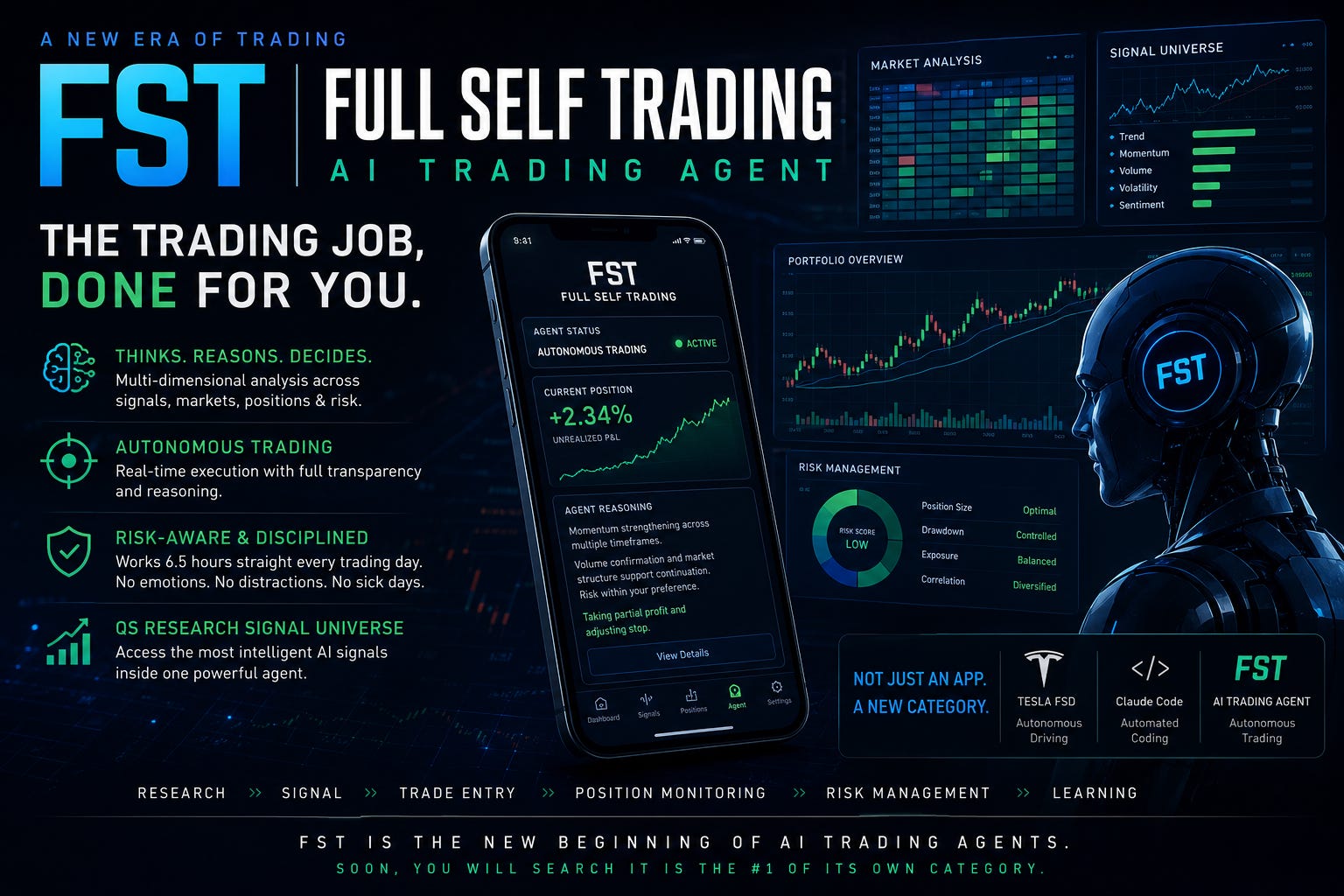
Introducing FST: the AI agent built to perform the entire trading job
You have probably heard the term AI agent.
A chatbot answers a question.
An agent does the work.
That distinction is why products such as Claude Code and Codex have become so powerful. They do not merely explain how to write software. They can inspect a codebase, use tools, create files, fix errors, run tests, and complete an engineering task.
They were designed around one profession: software development.
Their models, tools, memory, workflows, and interfaces all exist to help programmers build better software.
That raises an obvious question.
Where is the equivalent agent for traders?
Traders do not spend their days building web applications.
They research markets.
They evaluate signals.
They compare opportunities.
They size positions.
They manage risk.
They execute trades.
They monitor changing market conditions.
They decide whether to hold, add, reduce, hedge, or exit.
Yet most traders still perform this work by jumping between charting platforms, news feeds, Discord alerts, broker applications, spreadsheets, social media, and rule-based automation tools.
AI transformed software engineering first.
Trading is next.
A Coding Agent Is Not a Trading Agent
Claude Code and Codex are exceptional products.
But they are not traders.
A general-purpose agent can write code related to trading. It can explain indicators, generate a backtest, or help connect an API.
That does not make it capable of operating a live trading workflow.
A real trading agent requires a fundamentally different architecture.
It needs access to market data, signals, positions, broker accounts, risk constraints, portfolio exposure, execution tools, and continuous market context.
It must understand that a trade is not an isolated command.
Every decision depends on multiple dimensions:
What is happening in the broader market?
Which signals agree or disagree?
Is the opportunity already crowded?
What positions are already open?
How much risk is currently deployed?
What is the expected upside relative to the downside?
Has the original thesis changed?
Should the agent enter, wait, reduce, hedge, or do nothing?
Traditional automation does not reason through these questions.
It follows instructions.
A moving average crosses another moving average, so it buys.
A price reaches a threshold, so it sells.
A number changes, so a rule fires.
That was automation.
It was not intelligence.
Why I Built FST
As the founder of QuantSignals, I tested nearly every major agent framework available.
I wanted an agent that could operate the trading workflow I use every day.
Not a coding assistant with a broker API attached.
Not a chatbot that generates analysis and then asks me to complete the trade manually.
Not a rigid bot executing one-dimensional rules.
I wanted an agent designed by a trader, for traders, from day one.
I could not find it.
So I built it.
FST stands for Full Self Trading.
FST is an AI trading agent designed to perform the full lifecycle of a trade:
Research → Signal → Trade Entry → Position Monitoring → Risk Management → Learning
It brings the intelligence layer and the execution layer into one system.
That is the critical difference.
Most market products live on only one side.
Signal platforms generate ideas but do not execute.
Brokers execute trades but do not provide deep decision intelligence.
Charting platforms visualize markets but still require the trader to interpret everything manually.
Legacy automated systems execute rules but cannot reason dynamically.
FST connects the entire process.
I Deleted My Other Trading Apps
I did not build FST as a theoretical product.
It is the trading agent I use myself.
In fact, I intentionally removed the other trading applications from my phone and laptop.
TradingView: gone.
Twitter as a primary market-news feed: gone.
Standalone broker applications: no longer necessary once the accounts are connected to FST.
That was not a marketing stunt.
It was a product test.
Could one intelligent agent replace the fragmented collection of tools that traders have accumulated over the last two decades?
For my own workflow, the answer is increasingly yes.
Through FST, I can access the QS Research signal universe, analyze an opportunity, connect the analysis to my current portfolio, review risk, execute through a connected broker, and continuously monitor the position.
The intelligence does not disappear after the order is submitted.
The agent remains involved throughout the life of the trade.
The QS Signal Universe Is the Brain
An agent is only as strong as the information and tools available to it.
A coding agent has access to source code, terminals, files, tests, documentation, and software-development tools.
A trading agent needs its own native intelligence infrastructure.
FST is connected to the QS Research signal universe.
It can evaluate signals across different strategies, time horizons, assets, and market conditions instead of relying on one indicator or one isolated model.
This matters because markets are multidimensional.
A trade may look attractive based on price momentum but weak based on options flow.
A strong company may still be a poor entry at the wrong valuation or under the wrong market regime.
A bullish signal may be valid in isolation but dangerous when the portfolio is already overexposed to the same factor.
FST is designed to consider these interactions.
It does not merely ask, “Is this signal bullish?”
It asks, “Does this trade make sense now, for this account, under these conditions, with this level of risk?”
That is the difference between receiving information and operating intelligently.
Autonomous Trading That Can Actually Reason
The most important capability inside FST is autonomous trading.
You can think of it simply as auto trading, but it is fundamentally different from the previous generation of automated systems.
Traditional auto traders follow predefined rules.
FST is designed to reason across:
The QS signal universe
Real-time market conditions
Existing positions
Available capital
Portfolio exposure
Risk preferences
Trading goals
User-defined constraints
It can evaluate opportunities, select actions, and explain the reasoning behind those actions.
Transparency matters.
A black-box system that moves money without explaining itself is not an intelligent partner. It is an operational risk.
FST reports what it is doing, what information it considered, and why it reached its conclusion.
The trader remains informed even when the agent is operating autonomously.
Agents Do Not Get Tired
Human traders have biological limits.
We lose concentration.
We become emotional.
We hesitate after a loss.
We become overconfident after a win.
We become distracted.
We force trades when nothing is there.
We miss opportunities because we are tired, busy, or away from the screen.
FST does not experience those problems.
It can watch the market throughout the entire trading session.
It does not need a lunch break.
It does not revenge trade.
It does not panic because a position temporarily moves against it.
It does not become attached to a ticker.
It does not abandon the risk plan because of fear or excitement.
The purpose is not to pretend that AI eliminates market risk.
It does not.
The purpose is to remove avoidable human inconsistency from research, execution, monitoring, and risk management.
Tesla FSD for Trading
The easiest way to understand FST is through two analogies.
Tesla FSD performs the driving required to move toward a destination.
Claude Code performs the engineering work required to turn instructions into software.
FST performs the trading work required to turn market intelligence and user objectives into managed trade decisions.
Tesla FSD does not simply tell you how to turn the steering wheel.
Claude Code does not merely give you a paragraph explaining how to edit a file.
They act.
That is the standard an AI trading agent must meet.
A trading chatbot is not enough.
A signal generator is not enough.
A broker connection is not enough.
The agent must operate the entire mission.
This Is Not Another Trading App
FST is not trying to become another charting platform.
It is not trying to become another broker interface.
It is not trying to become another alert service.
Those are products from the previous era.
FST represents a new product category:
AI Trading Agents
The winning product in this category will not be the one with the most charts.
It will be the one that combines the strongest intelligence, the widest signal universe, the most reliable execution, the best risk framework, and the deepest understanding of the trader’s objectives.
That is what we are building at QuantSignals.
Today, people search for coding agents and immediately find clear category leaders.
Soon, they will search for AI trading agents too.
Our goal is equally clear:
FST will define the category—and become the first name traders associate with it.
The era of manually assembling a trading workflow from ten disconnected applications is ending.
The agentic trading era is beginning.